Platform · deployment control
PaaS Platform
A personal PaaS that models service deployment, runtime state, authority, and routing across multiple nodes.
- Period
- 2026 — present
- Role
- Platform engineer
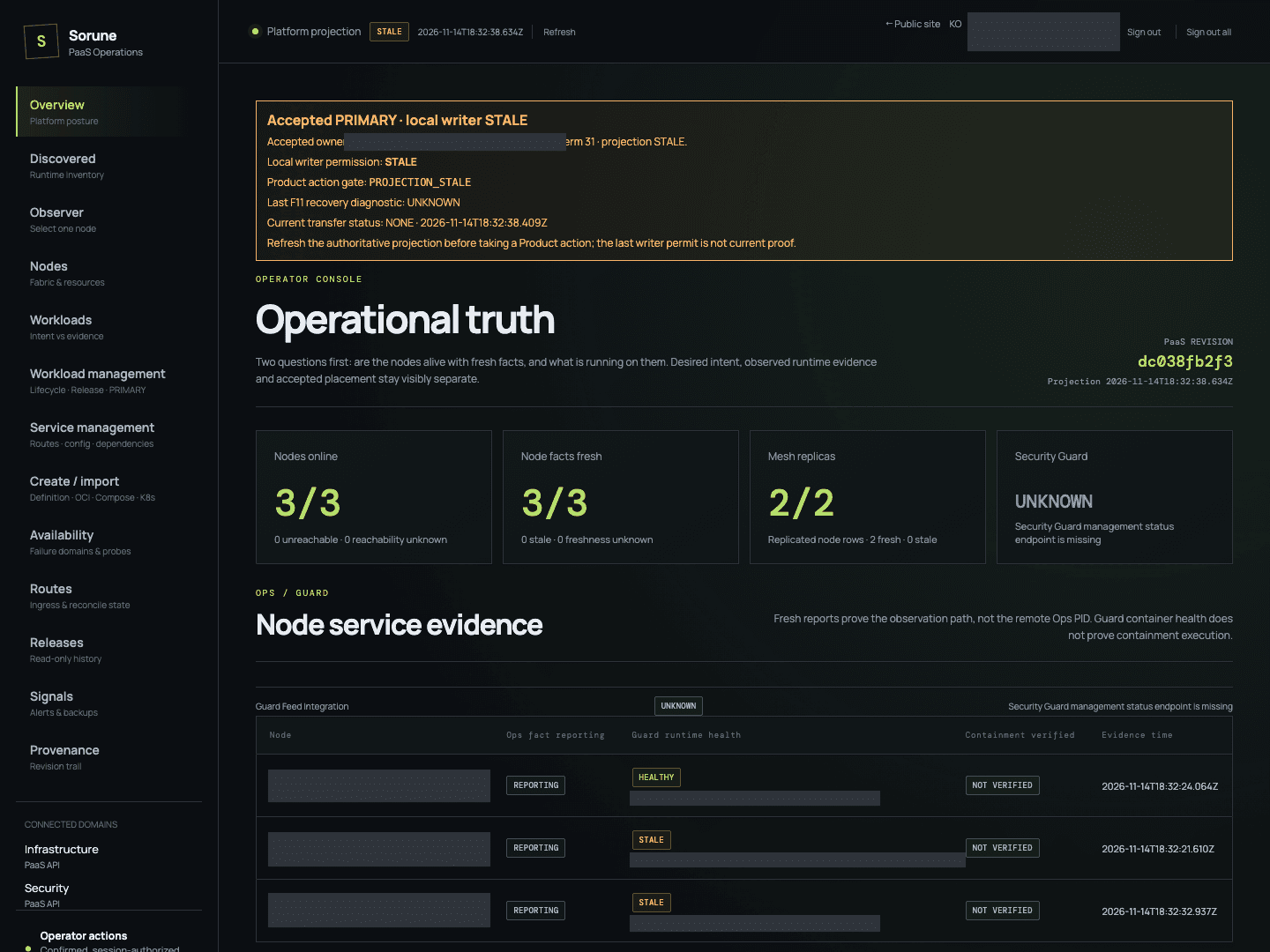
Problem
09Per-host deployment actions and divergent placement data make it difficult to know which state and authority are valid.
Related systems
One platform, separate responsibilities
Responsibility boundaries from source contracts; not deployment topology or an asserted call sequence.
PaaS Platform
Owns projects, services, workloads and deployment intent.
Does not own node-local physical runtime facts.Current projectServer Ops
Owns node-local observation, execution and infrastructure.
Does not replace product approval and control intent.Security Guard
Correlates security signals and delegates node actions to Ops.
Separates detection/decision from node actuation.PaaS APM
Collects and queries application HTTP/DB traces and metrics.
Does not own node infrastructure or incident authority.Constraints
- Separate deployment decisions from node-local observations.
- Never confuse a deployment plan or candidate with successful live acceptance.
- Preserve provenance and freshness across nodes.
Engineering decisions
- Keep Product/Control Plane and Server Ops responsibilities separate.
- Model projects, services, workloads, and deployments explicitly.
- Tie operations and mobility to state transitions with evidence.
Implementation
- Built a TypeScript/NestJS API, operational console, and product/workload model.
- Separated IAM/RBAC, projection, Mesh, and execution contracts.
- Validate actual deployment and acceptance as distinct stages.
Verification / evidence
The paas-platform repository contains its NestJS API, console, domain/contracts, and deployment modules.
Result / current state
A multi-node platform with explicit control and runtime contracts, while automated deployment acceptance remains evidence-gated.