Application observability · APM
PaaS APM
An independent application telemetry system for transaction traces, metrics and scoped queries.
- Period
- 2026 — present
- Role
- APM system engineer
Problem
15Infrastructure health alone does not explain HTTP, database and outbound-call latency.
Related systems
One platform, separate responsibilities
Responsibility boundaries from source contracts; not deployment topology or an asserted call sequence.
PaaS Platform
Owns projects, services, workloads and deployment intent.
Does not own node-local physical runtime facts.Server Ops
Owns node-local observation, execution and infrastructure.
Does not replace product approval and control intent.Security Guard
Correlates security signals and delegates node actions to Ops.
Separates detection/decision from node actuation.PaaS APM
Collects and queries application HTTP/DB traces and metrics.
Does not own node infrastructure or incident authority.Current projectConstraints
- Do not duplicate PaaS node monitoring or claim persistence without source-to-query evidence.
- Node/container telemetry and application request traces have separate ownership.
- Loopback provider tests do not establish production security, durability or retention.
Engineering decisions
- Keep OpenTelemetry instrumentation, authenticated Gateway, backend providers and scoped queries distinct.
- Separate Spring instrumentation, Collector ingestion, native providers and authenticated queries.
- Bound R1 acceptance to source identity, timestamps, tenant isolation and provider recovery.
Implementation
- Synthetic R0 instrumentation, scoped R1 native providers, R2 active requests/snapshots and R3 alert evaluation/delivery each have bounded acceptance evidence.
- R0 uses a synthetic Spring MVC path covering HTTP, JDBC, outbound calls and JVM signals.
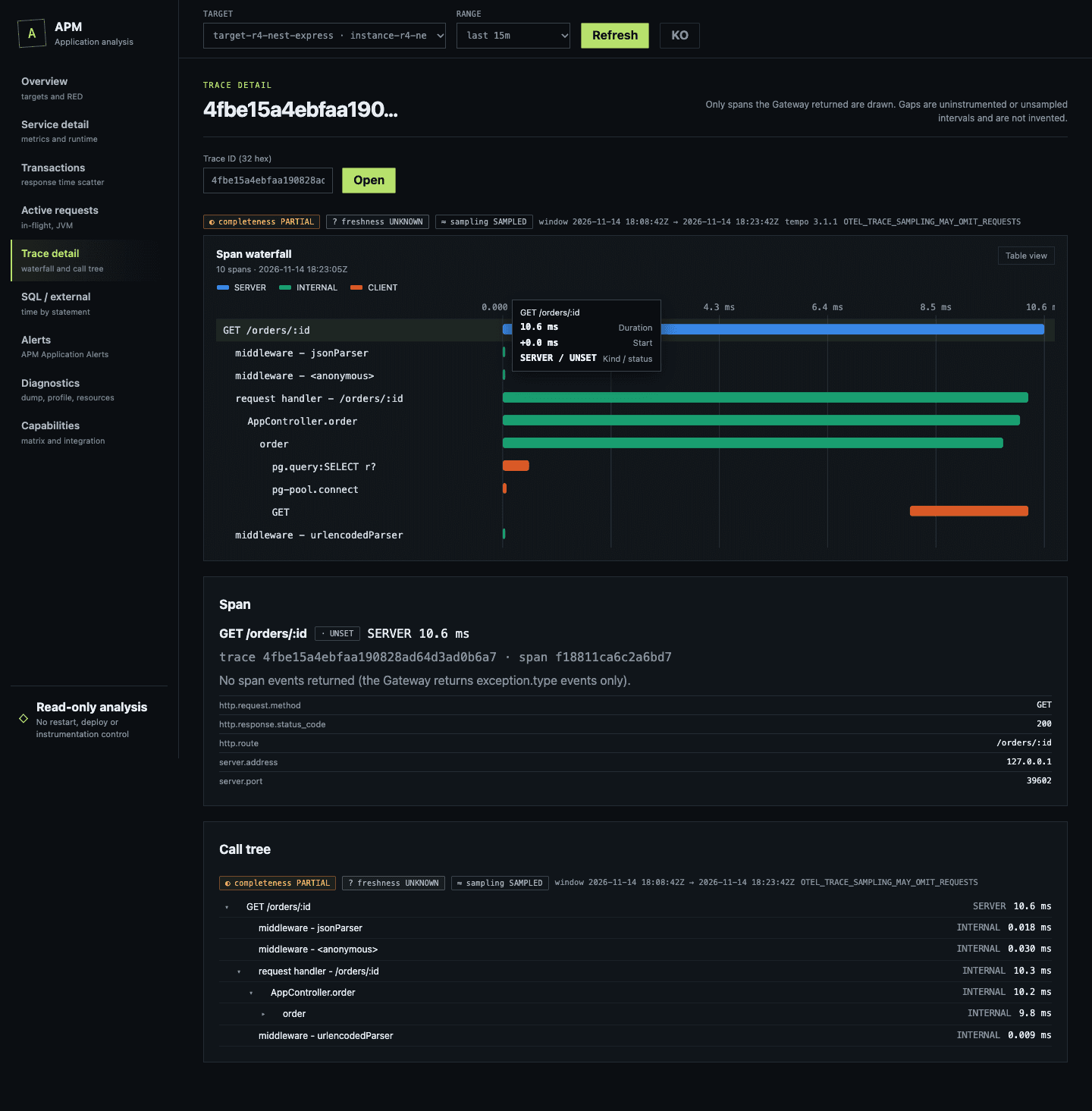
- Scoped R1 verifies authenticated Prometheus/Loki/Tempo queries; R2 covers active requests, snapshots and call trees; R3 covers application-alert evaluation and delivery.
Verification / evidence
R0–R3 reports and the 2026-11-13 independent R3 verdict support only scoped acceptance; producer delivery does not prove PaaS persistence or production readiness.
Result / current state
R0–R3 passed their scoped synthetic/fixture gates. R4–R5 integration test screens are available separately; production/PaaS integration is not included in that acceptance.